Quadratic equations: Drawing parabolas
 Drawing of parabolas
We have seen that the graph of a quadratic is a parabola. We have also seen how the intersection points with the axes, the vertex and other points with particular values of #x# of the parabola can be calculated. From these calculated values we can easily draw the graph of a quadratic.
Procedure drawing parabola
| Procedure |
geogebra plaatje
|
|
|
We will draw the graph of a quadratic. |
||
| Step 1 |
Determine the intersection point with the #y#-axis. |
|
| Step 2 |
Determine the vertex. |
|
| Step 3 |
Determine the intersection points with the #x#-axis, if there are any. |
|
| Step 4 |
Substitute values for #x# in the formula in such a way that we have at least 4 points we can draw. |
|
| Step 5 |
Draw these points in the coordinate system and connect them by a smooth parabola. |
\[y={{x^2}\over{5}}+3\cdot x-9\]
Draw the intersection with the #y#-axis, the vertex, and the intersections with the #x#-axis.
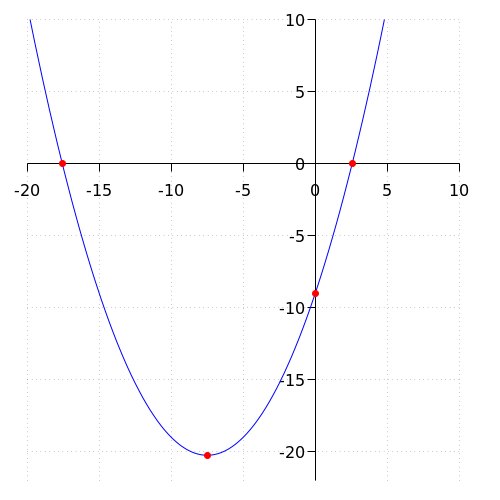
The red dots are the four dots from the question. These are calculated as follows:
The formula is already written in the form of #a \cdot x^2+b \cdot x +c# with #a ={{1}\over{5}}#, #b=3# and #c=-9#. Seeing as #a>0# the graph is a parabola that opens upward.
The intersection with the #y#-axis is equal to the value of the constant in the quadratic formula, which is equal to #-9#. That means that the coordinates of the intersection point with the #y#-axis are #\rv{0,-9}#.
The #x#-value of the vertex is given by #x=-\dfrac{b}{2 \cdot a}# and is equal to:
\[\begin{array}{rclrl}
x&=& -\dfrac{3}{2 \cdot {{1}\over{5}}} &&\phantom{xxx}\blue{\text{formula entered}}\\
&=& -{{15}\over{2}} &&\phantom{xxx}\blue{\text{simplified}}\\
\end{array}\]
The #y#-value of the vertex is calculated by entering #x=-{{15}\over{2}}# in the formula. Which gives:
\[\begin{array}{rclrl}
y&=& {{1}\over{5}} \cdot \left(-{{15}\over{2}}\right)^2 +3 \cdot -{{15}\over{2}} -9
&&\phantom{xxx}\blue{\text{formula entered}}\\
&=& -{{81}\over{4}} &&\phantom{xxx}\blue{\text{calculated}}\\
\end{array}\]
The coordinates of the vertex are: #\rv{-{{15}\over{2}},-{{81}\over{4}}}#. To draw the point in the graph, we have to write the coordinates as decimal numbers (rounded to 1 decimal). That gives: #\rv{-7.5,-20.2}#.
The intersections with the #x#-axis are the points that correspond to #y=0#.
\[\begin{array}{rcl}
{{x^2}\over{5}}+3\cdot x-9 &=& 0 \\&&\phantom{xxx}\blue{\text{the equation that should be calculated}}\\
x=\dfrac{-{3}-\sqrt{3^2-4 \cdot {{1}\over{5}} \cdot -9}}{2 \cdot {{1}\over{5}}} &\vee& x=\dfrac{-{3}+\sqrt{3^2-4 \cdot {{1}\over{5}} \cdot -9}}{2 \cdot {{1}\over{5}}} \\&&\phantom{xxx}\blue{\text{quadratic formula entered}}\\
x={{-9\cdot \sqrt{5}-15}\over{2}} &\vee& x={{9\cdot \sqrt{5}-15}\over{2}} \\&&\phantom{xxx}\blue{\text{calculated}}\\
\end{array}\]
The coordinates of the intersections with the #x#-axis are: #\rv{{{-9\cdot \sqrt{5}-15}\over{2}},0}# and #\rv{{{9\cdot \sqrt{5}-15}\over{2}},0}#. To draw the point in the graph, we have to write the coordinates as decimal numbers (rounded to 1 decimal). That gives:#\rv{-17.6,0}# and #\rv{2.6,0}#.
The four points in the graph are: #\rv{0,-9}#, #\rv{-{{15}\over{2}},-{{81}\over{4}}}#, #\rv{{{-9\cdot \sqrt{5}-15}\over{2}},0}# and #\rv{{{9\cdot \sqrt{5}-15}\over{2}},0}#.
The requested points are connected by a smooth curve in the figure: the parabola that opens upward is given by the formula.